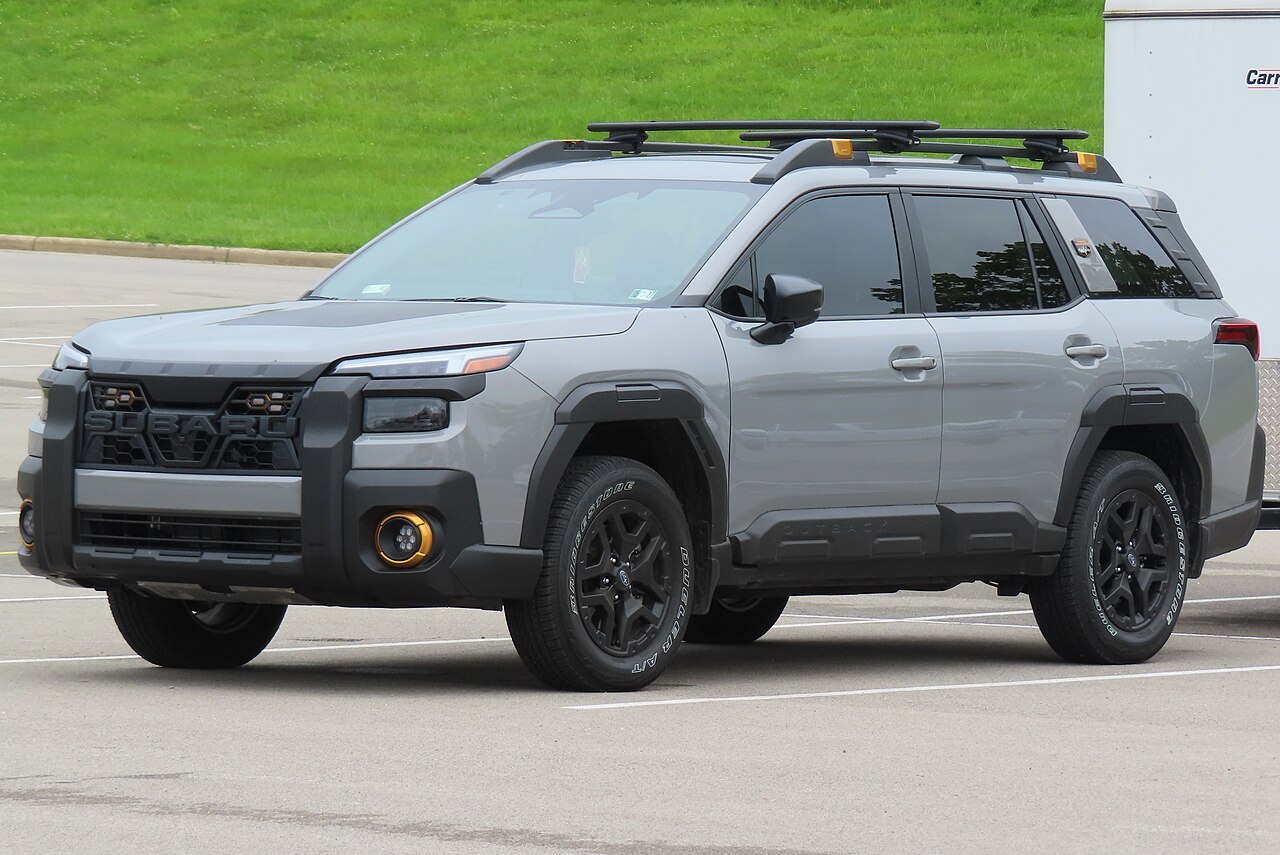
The 2017 Subaru Outback has 917 NHTSA owner complaints and 4 recalls on file (U.S. federal records, as of September 2026). The most-reported system is electrical at 381 complaints, typically surfacing around 32,431 miles (~$850 to repair). Source: NHTSA Office of Defects Investigation.
Average for the segment. Some recurring trouble spots worth knowing about.
0
Critical
4
Severe
0
Moderate
Should you avoid this 2017 Outback?
Acceptable — with caveats
Worth owning if you verify the specific issues below before you buy.
Cruise-control: 25 complaints, classified severe, failures cluster 9,190–41,000 mi
Reliability score 6.0/10 — around the segment average
4 recall campaigns on file
Our read of the federal NHTSA complaint and recall record for this exact year and model —
not a substitute for a pre-purchase inspection. How we score.
NHTSA crash-test safety ratings
5 / 5 overall
Overall★★★★★5/5
Frontal crash★★★★★5/5
Side crash★★★★★5/5
Rollover★★★★★4/5
Driver-assist features on the tested model:
Electronic stability control: Standard · Forward collision warning: Optional · Lane departure warning: Optional
Source: NHTSA New Car Assessment Program — tested configuration: 2017 Subaru Outback SW AWD. Stars rate crash protection in NHTSA's tests, not overall reliability — see the owner-complaint data below for what actually goes wrong.
Buying a used 2017 Subaru Outback? Check these first
Here's what this model is known to do — so you can inspect for it, price it in, or
make the seller fix it before you sign.
What to inspect on this specific car
electrical — 381 owner reports
· tends to show around 32,431 mi · ~$850 to fix
visibility — 217 owner reports
· tends to show around 39,385 mi · ~$350 to fix
powertrain — 42 owner reports
· tends to show around 30,143 mi · ~$2,500 to fix
cruise control — 25 owner reports
· tends to show around 33,038 mi · ~$600 to fix
⚠ The one to take seriously: cruise control is flagged
severe on this model
, showing up around 33,038 mi.
Inspect it closely on a test drive.
Recalls to confirm are done
Run the VIN from the listing — 4 active recalls on this model. Recall repairs are always free.
Verdict for buyers: 6.0/10 model. The priciest documented failure is
engine (~$3,100) — get the
seller's service records for it or inspect closely. Otherwise an average-risk used buy at a fair price.
We tell you what this model is known for and what to inspect — a vehicle-history report
tells you what this exact car has been through. Smart buyers get both.
A noise, a warning light, a repair quote, "should I buy this?" — get an answer grounded in
this vehicle's actual NHTSA record, not generic advice.
Dash light, leak, worn part — snap it and we'll read it against this car's record.
Photo attached — type a question or just hit Ask.
Answers use this vehicle's NHTSA complaint & recall record — owner-reported and unverified, not a diagnosis. Verify anything safety-critical with a mechanic.
Embed this reliability snapshot
Free to use on your site, post, or video — just keep the "Source" credit line below the chart. Preview the widget →
The Outback is a safe, capable, easy-to-live-with family car — but a buyer should know that 2017-2018 are actually the higher-complaint years of that generation in our data (2017 around 900, 2018 close to 800). The good news is why: it’s not engines grenading, it’s a few very specific, well-known issues.
What’s actually driving the number
The windshield. This is THE 2015-2019 Outback/Legacy issue. They crack from tiny impacts or seemingly nothing, and the acoustic windshield is ~$1,000+ to replace. It’s a huge chunk of the complaint count — annoying, not a safety/mechanical failure. Budget for it and make sure she has good glass coverage.
The CVT. It’s the Subaru Lineartronic CVT, number seven on our worst-platforms list. The Outback is heavier than the small Subarus, so it works harder. Subaru extended the CVT warranty (often 10yr/100k) on this generation — check whether that still applies, confirm fluid service, and test for shudder/hesitation off the line.
Oil consumption + battery. The FB25 had an oil-consumption history (worst 2011-2015, improved by 2017-2018 — check the level). Dead-battery/parasitic-drain complaints are also common; a slow crank after sitting is the tell, not a bad engine.
Should you buy one?
Yes — it’s a genuinely good, safe family pick (IIHS Top Safety Pick-grade, EyeSight on most trims, durable mechanically). The conditions:
Confirm the CVT was serviced and check remaining extended CVT coverage
Check oil consumption
Go in knowing a windshield is probably in its future
None of that is catastrophic. Priced right with those boxes checked, a 2017-2018 Outback is a smart buy. On an out-of-warranty CVT, run the warranty math — that’s exactly the calculation it’s built for.
When owners report each system failing, in actual miles — so you can see what's likely behind you,
what's due around now, and what to budget for next. Enter your mileage to mark where you are.
"Typical" = median owner-reported failure mileage from the NHTSA complaint record for this exact
year and model. Not a maintenance schedule — a heads-up on where this model's failures cluster.
What owners are saying
recent NHTSA-filed complaints · verbatim
2017 Outback· steering
While traveling through michigan's upper peninsula and northern wisconsin during snow fall with a fully packed car on the highway I experienced the rear end "ghost walking" or "steering" or "pulling" to the left and to the right. I had to drive 40mph while two-wheeled drive…
11/06/23: During a routine oil change at the dealer a multipoint vehicle inspection was conducted. The inspection revealed an upper oil pan leak. The repair involved removing the engine and replacing various components (gasket, O-Rings and etc.). The vehicle was well…
Tl* the contract called on behalf of his father who owns a 2017 Subaru outback. The contact stated that the battery was replaced on several occasions. The contact stated that the vehicle was taken to miller hill Subaru (4710 miller trunk hwy, duluth, mn 55811) where the failure…
My 2017 Subaru Outback will not start after sitting all night I’ve had diagnostics ran on the battery and it shows 100% charge. After charging the battery it held until the next day it was drained again. It was snowing with winds 50 mph, and I had to jump my car to start it. The…
Had a problem with your 2017 Subaru Outback?
File a complaint with NHTSA → It's free and official — owner filings are what build the federal safety record behind this page.
Estimate your repair exposure
Drag to your current mileage. Numbers are derived from this vehicle's complaint history.
In the event of a crash necessitating passenger frontal air bag deployment, the air bag may not deploy properly, increasing the risk of injury.
Fix: Subaru will notify owners, and dealers will replace the passenger air bag module, free of charge. The recall began February 3, 2020. Owners may contact Subaru customer service at 1-844-373-6614. Subaru's number for this recall is WUX-09.
If the knee guard is not properly attached and the driver is not wearing a seatbelt, the knee guard may not be able to properly restrain the driver's lower body in the event of a crash, increasing the risk of injury.
Fix: Subaru will notify owners, and dealers will inspect the knee guard welding on each vehicle's steering beam, replacing the beam as necessary, free of charge. The recall began November 14, 2016. Owners may contact Subaru customer service at 1-800-782-2783. Subaru's number for this recall is WTL-72.
If any of the front brake caliper, wheel hub or stabilizer clamp attaching bolts loosen or detach, the related components would also become loose and may detach possibly making the vehicle unstable and reducing the braking capability. These conditions would increase the risk of a crash.
Fix: Subaru has notified owners, and dealers will inspect the bolts for proper torque, and replace any loose bolts, free of charge. The recall began on August 8, 2016. Owners may contact Subaru customer service at 1-800-782-2783. Subaru's number for this recall is WTE-66.
It's got known weak points. With a reliability score of 6.0 out of 10 based on 917 owner complaints filed with NHTSA, the 2017 Subaru Outback has a higher-than-average rate of reported issues. The areas to watch are listed above. Whether it's worth owning depends on price, condition, and how much repair exposure you can absorb.
Should you avoid the 2017 Subaru Outback?
The 2017 Subaru Outback is acceptable, with specific caveats. Worth owning if you verify the specific issues below before you buy. The record behind that call: Cruise-control: 25 complaints, classified severe, failures cluster 9,190–41,000 mi; Reliability score 6.0/10 — around the segment average; 4 recall campaigns on file. This is our read of the federal complaint and recall data — not a substitute for a pre-purchase inspection.
What should I check before buying a used 2017 Subaru Outback?
Inspect the electrical first — it's the most-reported issue on this model, with 381 owner complaints filed. Typical failure occurs around 32,431 miles. Average repair cost runs about $850 at an independent shop. Also confirm any open recalls have been completed by running the VIN, and ask for service records covering the problem areas listed above.
Is the 2017 Subaru Outback a good used car to buy?
It scores 6.0 out of 10 on our NHTSA-based read of 917 owner complaints. The main thing to watch is electrical. Typical failure occurs around 32,431 miles. Priced fairly and clean on inspection, it's a reasonable used buy. Our data covers what this model is known for — pair it with a vehicle-history report on the VIN to see what that specific car has been through.
What's the most common problem on the 2017 Subaru Outback?
Based on NHTSA records, the most-reported issue is electrical, with 381 complaints filed. Typical failure occurs around 32,431 miles. Average repair cost runs about $850 at an independent shop.
What's the most expensive thing that goes wrong?
The electrical is one of the costlier repair items. Average repair cost runs about $850 at an independent shop. Typical failure occurs around 32,431 miles. Catching early warning signs can sometimes extend life by 20–30,000 miles.
How do I check if my Subaru Outback has open recalls?
Paste your VIN into the decoder at the top of this page. We pull live from NHTSA, so you'll see exactly which campaigns apply to your vehicle and whether the dealer has logged the fix. Recall repairs are always free regardless of mileage or warranty status.
Is an extended warranty worth it on a 2017 Subaru Outback?
Math is straightforward: a quality service contract runs $1,800–3,500 over 3 years. With 917 complaints on file and the costliest repair averaging $850, one major failure more than pays for it. The catch is reading the contract — many providers exclude wear items and require pre-authorization, so cheaper plans are not always better value.
Recall and complaint data sourced from the National Highway Traffic Safety Administration (NHTSA)
public records database, last synced 22 hours ago. Verify the raw federal record at
nhtsa.gov/vehicle/2017/Subaru/Outback.
Editorial commentary written by ProblemsByVin contributors and reviewed by ASE-certified mechanics.
We are not affiliated with Subaru. Some links on this page are affiliate links and we
may earn a commission if you purchase through them.