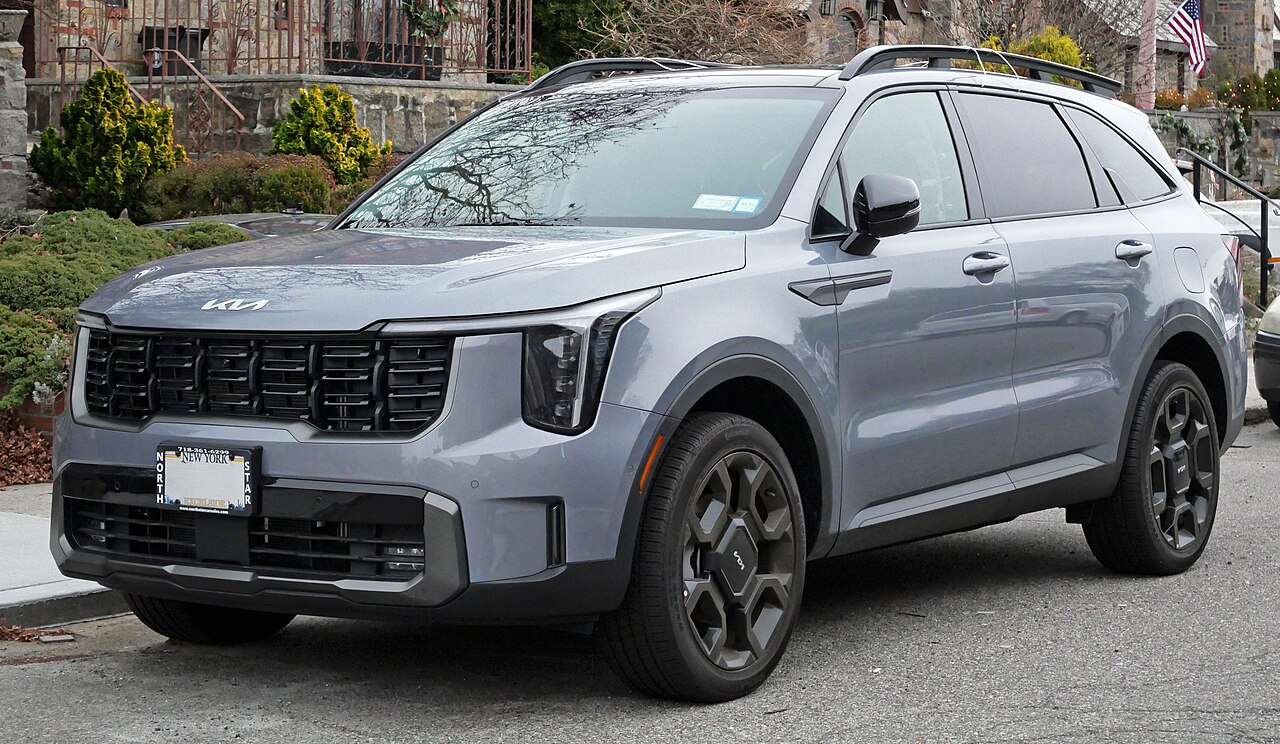
If you’re looking at a 2016 Kia Sorento, the first and almost only question that matters is which engine is in it. Get that right and the rest of the car is a perfectly good family SUV. Get it wrong and you’ve bought one of the most documented engine failures of the last fifteen years.
The 2016 Sorento has over 1,200 NHTSA owner complaints and one of the weaker reliability scores in our database. It’s the first year of that generation, so some of that is launch-year teething. But the heavy part of it is the engine.
The 2.4L Theta II — number two on the list
If the Sorento has the 2.4L four-cylinder, that’s the Hyundai/Kia Theta II. It’s the second-worst platform in our entire database — over 24,000 owner complaints across the vehicles it went into. We wrote up why a handful of engines and transmissions account for most of the complaints and the Theta II is one of the biggest reasons that pattern exists.
It fails from rod-bearing oil starvation. The bearing wears, the engine starts knocking, and then it either spins a bearing or seizes outright — often well under 100,000 miles, sometimes with no warning a driver would recognize in time. In a fraction of cases it has led to engine fires.
Hyundai and Kia were hit with a large class-action settlement over this. That settlement is the single most important thing for a used buyer to understand, because it cuts both ways:
- These engines frequently got replaced for free under the settlement. A 2016 Sorento with a documented engine replacement is, counterintuitively, often a safer buy than one with its original engine — the new unit is generally the improved part and the failure is behind it.
- The settlement also added a lifetime engine warranty extension and a knock-sensor detection software update (KSDS) that monitors for the early signs and limits damage.
What you’ll see and hear
- A deep knock or rod-knock from the bottom end, often louder on cold start, getting worse with rpm
- Oil consumption climbing — having to add oil between changes
- The oil light or a sudden loss of pressure
- Engine seizure, sometimes preceded by very little warning
Should you buy one?
A 2016 Sorento 2.4 is buyable, but only on these terms:
- Confirm the engine. Was it ever replaced under the recall/settlement? Get the paperwork. A replaced engine with documentation is the best-case version of this car.
- Confirm the KSDS software update was done. It’s free and it’s the early-warning system. No update is a red flag on an original engine.
- Get every document and keep it. The lifetime engine coverage follows the car. It’s worthless to you without the paper trail, and it’s a real asset if you ever sell.
- On an original-engine car with no KSDS and no records — walk. You’d be buying the number-two platform on our list with no safety net.
If it’s the 3.3L V6 (Lambda), that’s a completely different and far more durable engine — it does not share the Theta rod-bearing problem and isn’t on our list. On this generation, the V6 is the one to want by a wide margin.
The transmission, AWD, and the rest of the Sorento are ordinary and fine. This is an engine decision, full stop. Before you commit on a 2.4, it’s worth running the warranty math on it — the complaint data and the class-action coverage status genuinely change the answer here.